


Water Source Management: The Key to Reliable Industrial Water Treatment

The Hidden Reason High-End Water Treatment Systems Fail
It’s a scenario that plays out repeatedly across commercial and industrial operations. A business invests in a state-of-the-art industrial water treatment system or commercial water treatment setup, complete with multi-stage filtration, precise dosing pumps and a high-efficiency reverse osmosis (RO) unit. On day one, the results are excellent and the operation runs seamlessly.
Then, a few months later, the alarms start sounding.
When an unexpected shutdown occurs, facility managers typically ask two questions: “Why does my system keep tripping? or “Why is my RO plant not producing water?”
The initial assumption is often that something has gone wrong within the treatment plant itself. But in many cases, the underlying issue can be traced further upstream to an overlooked part of the system: proper water source management.
A treatment plant is only as reliable as the raw feed water supplied to it. Without a thorough understanding of your water source and ongoing optimisation of its supply, even the most advanced treatment technology can struggle to perform consistently.
Understanding the difference between water source problems and water treatment problems is therefore essential to keeping your operation online, protecting your treatment equipment and avoiding unnecessary downtime.
Why Water Source Management Matters for Industrial Water Treatment
A high-performance water treatment system is designed around specific feed-water conditions. When the characteristics of the incoming water change beyond the system’s operating parameters, even well-designed equipment can experience reduced performance, increased fouling, inconsistent output or unexpected shutdowns.
For this reason, effective industrial water treatment starts before the water reaches the treatment plant. Understanding the quality, quantity and reliability of the raw water source is fundamental to designing and operating a resilient treatment system.
Water Quality vs. Water Quantity: The Crucial Distinction
When evaluating a raw supply, it is easy to conflate volume with usability. Sustainable facility management requires treating water quality vs. water quantity as two distinct metrics:
Water Quality: Understanding the Raw Feed Water
Water quality refers to the physical, chemical, and biological profile of the water (e.g., total dissolved solids, hardness, iron content, suspended solids). Quality dictates how the water must be treated.
Water Quantity: Ensuring a Reliable Water Supply
Water quantity refers to available flow rates, total yield, and reliable supply over time. Quantity dictates whether the plant can run at all.
A site may have good water quality, but without enough volume, the treatment system will frequently trip on low-level protection. Conversely, an abundant flow rate means little if sudden shifts in water quality overwhelm your filter media and cause premature membrane fouling.
Managing Borehole Water Supply for Industrial Operations
For operations relying on a borehole water supply, protecting the source requires continuous monitoring. A common oversight is assuming groundwater availability is fixed or infinite. In reality, a single well’s yield depends heavily on local hydrogeology, and two wells located just meters apart can display drastically different yields and chemistry.
Here is what to consider:
Match Water Demand to Borehole Yield
Every source has a specific, safe borehole yield, the rate at which water can be abstracted sustainably without exhausting the aquifer. If an industrial process requires 10 m³/h, but the safe well yield is only 5 m³/h, drawing above that limit will cause the system to fail or force you to integrate additional supply points.
Account for Seasonal Groundwater Fluctuations and Recovery Rates
Boreholes during dry and wet seasons may vary. Every aquifer has a “recharge rate”, the time it takes for water to seep back into the well casing after being pumped out. If you pump continuously without allowing for recharge, you risk your borehole running dry. This can lead to damaging your pump or worse, collapse of the well wall itself.
The water quality from your boreholes may also vary through the seasons depending on rainfall, dilution during wet periods or concentration during dry spells, shifting parameters like Electrical Conductivity (EC). This makes it important to constantly monitor your groundwater for level and quality.
Manage Multiple Groundwater Sources and Blended Feed Water
When multiple wells are combined to meet volume requirements, managing the blended water profile becomes critical. If one well exhibits high EC and another low EC, the combined feed-water ratio must be carefully controlled.
Treatment plants tolerate minor operational ranges, but sharp variation in blended water quality impacts membrane fouling rates and output consistency.
Building a Resilient Water Treatment and Utility Design
Investing in high-quality treatment equipment is only part of a robust water management strategy. Long-term, uninterrupted production relies on establishing proper water source management as the foundation of your entire utility design.
By defining the safe operating limits of your raw supply, monitoring seasonal quality shifts, and utilising adequate buffer storage to smooth out demand peaks, you ensure your water treatment equipment receives the stable, consistent feed required to operate effectively year after year.
Designing Water Treatment Systems Around Your Water Source
The relationship between the water source and treatment system should be considered from the beginning of the design process. Borehole yield, seasonal variation, raw water quality, storage capacity and process demand all influence how a treatment plant should be configured and operated.
A properly assessed water source helps establish the right treatment approach while providing the operational information needed to keep the system performing reliably over time.
Start With the Right Treatment Approach
Every water source presents its own combination of quality, quantity and operational requirements. Book a meeting with Greenchain Group to discuss your water treatment needs and arrange a site visit. Our team can evaluate your water source, assess your specific requirements and recommend a treatment approach suited to your operation, with an initial evaluation at no cost to you.
FEATURED PROJECT
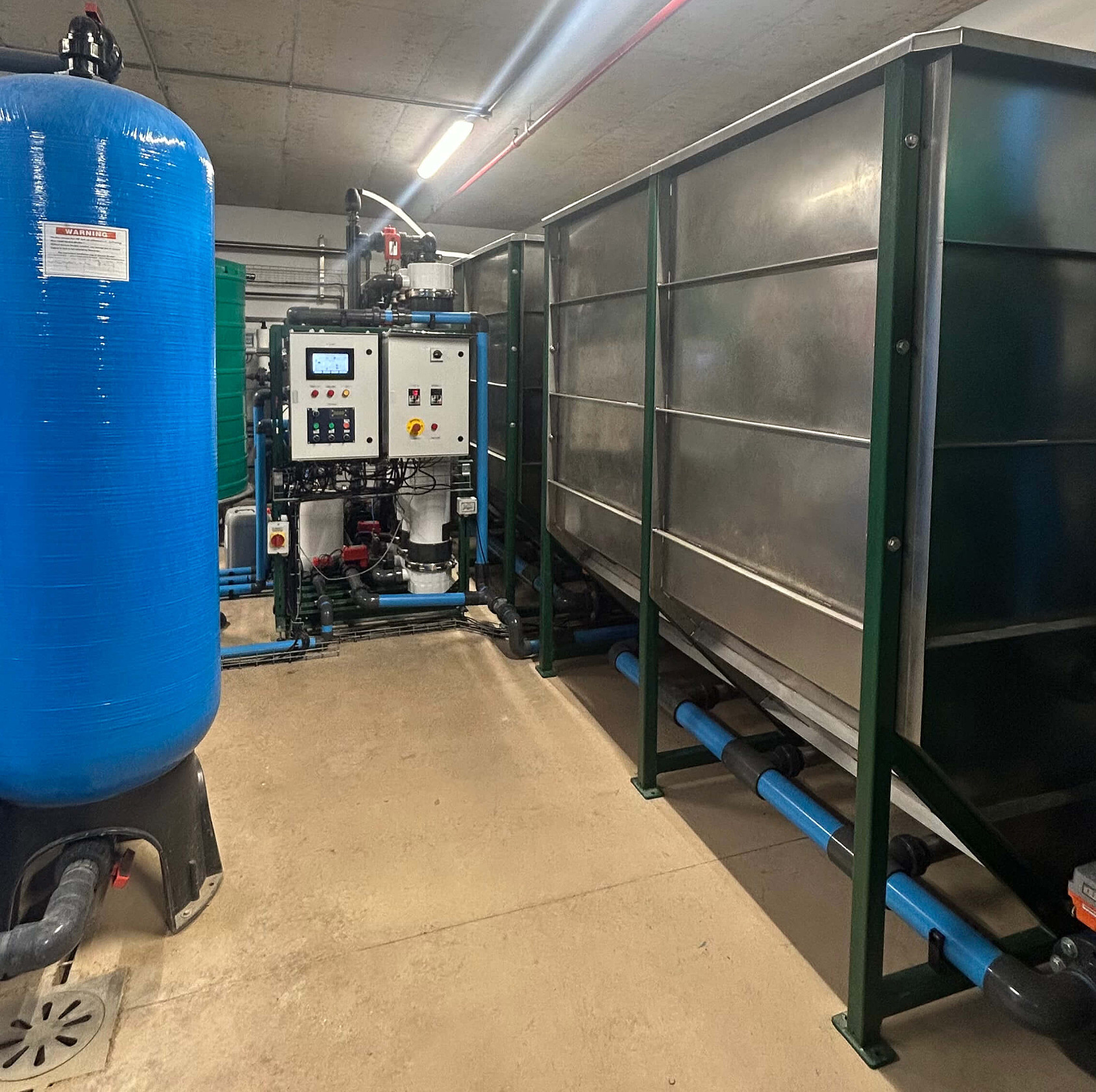
MULTI-SOURCE UF WATER TREATMENT
A high-performance ultrafiltration drinking water treatment system in the Western Cape, South Africa, designed to produce 8,500 litres per hour of safe potable water with flexible multi-source operation and smart monitoring.

Comments